
1–1 in regular time, 2–2 after extra time: which score is for the market?
Both scores may be correct but for different questions. Before comparing the ticket to the result display, find the period covered: regular time, extra time only, or the team that will advance after the tiebreak.
For the topic overview, see Does the feature-entry option cost extra?.

The market label determines which part of the game to read. The team name and the latest score are not enough. In our own example below, A advanced in penalties even though the regular-time result was a draw and the extra-time-only result was also a draw.
All time after 90:00 is not extra time
In IFAB Law 7, a standard match has two 45-minute halves and there is an allowance for time lost in each half. So the goal labeled 90+3 could still belong to second-half added time. Each second beyond the number 90 does not become a separate extra-time period.
In IFAB Law 10, extra time and penalty shoot-out are separate procedures when competition requires a winner. Two equal extra-time periods of not more than 15 minutes each may be used; the shoot-out is done after the match is over. The competition rules need to be checked to know what tiebreak is actually used.
Football laws explain the structure of the game. Ticket settlement is a separate matter that is in the operator’s market rules. An app label does not automatically become an IFAB betting rule.
Own example: record the boundaries first
Assume a fictitious single-match knockout which uses regular time, extra time and, if necessary, penalties. No aggregate score from the first leg. A and B are just labels, not real teams or a live prediction.
| Event | Score in the match | Period to be recorded |
|---|---|---|
| A scores at 32′ | 1–0 | Regular time |
| B scores at 90+3′ | 1–1 | Second-half added time, new whistle |
| Whistle at the end of regular time | 1–1 | Freeze the regular-time snapshot |
| A scores in 98′ | 2–1 | Extra time; A has 1 goal in this period |
| B scores at 112′ | 2–2 | Extra time; 1 goal each in this period |
| No more goals until after extra time | 2–2 | Extra-time-only score was 1–1 |
| Shoot-out: A 4, B 3 | Match score remains 2–2; penalties separately | A will advance in a false tie |
There are three important notes: regular-time score 1–1; extra-time-only score 1–1; advancing team A. A cumulative score of 2–2 after extra time is also useful, but it does not replace the first two snapshots.
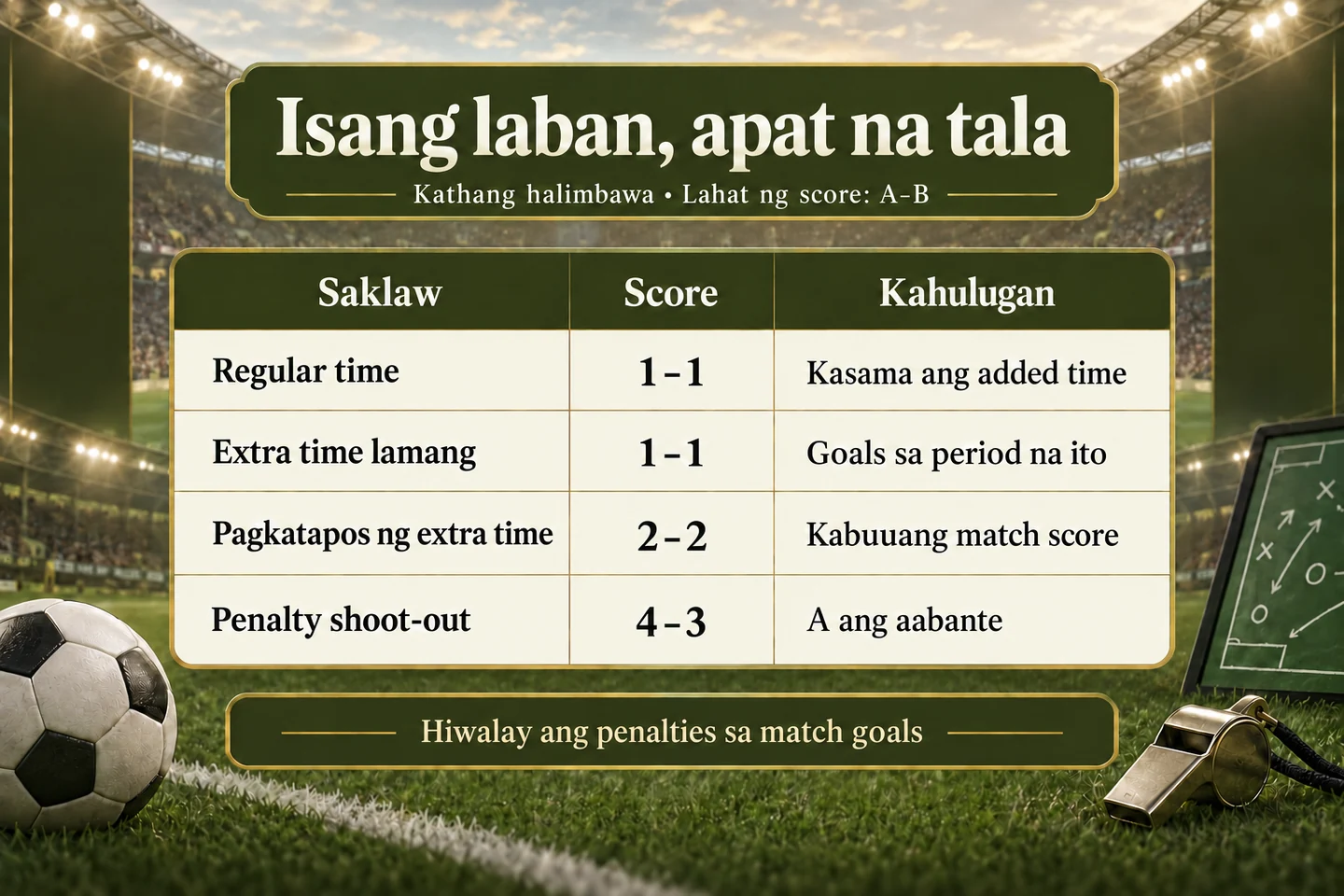
Same match, different answers to different questions
There is a concrete published example in Betfair Sportsbook Football/Soccer Rules: its default soccer scope is 90 minutes including added time, unless otherwise stated, and does not include extra time or shoot-outs. In your section Extra Time Correct Score, only the period is counted and its starting score is zero-zero. This is an example of the Betfair rule; that is not proof of the arionplay or the destination operator’s terms or available market.
If a fixture belongs to a two-leg tie, separate its result from the aggregate-score calculation.
For our own worksheet, assume three exact definitions: first, three-way result at the end of regular time plus added time; second, score of the extra-time period only; third, team that will advance with the applicable extra time and penalties. In these conditions:
- Regular-time three-way result: draw. 1–1 was not a winning result for A, even though A advanced afterwards.
- Extra-time-only correct score: 1–1. A and B added one goal each in that period, not two each.
- Team to advance: A. This is the answer because that is exactly the question in the third definition and A won the shoot-out in the example.
We do not assign odds, payouts or stakes. The worksheet is a mapping of the result to the scope, not a recommendation on which one to bet on. If the exact definition on the ticket is different, that must be used.
Separate goals from shoot-out kicks
In the regular-time snapshot, total goals is 1+1=2. Only in the extra-time period, 1+1=2 too. Throughout the match until the end of extra time, 2+2=4. The shoot-out tally of 4+3 is not added to make the ordinary match-goal count 11 in the model.
If a hypothetical Over 2.5 definition is regular time plus added time only, then 2 does not exceed 2.5. If the other hypothetical definition is a full match including extra time but not a shoot-out, then 4 will be exceeded. The answer has changed because the scope has changed, not because there is something wrong with the same arithmetic.
Shoot-out can be its own market, but that requires its own definition. Successful kicks cannot be added to other markets simply because they both appear on the final results page.
Four details before asking about settlement
Prioritize the event identity: teams, competition, leg if any, date and timezone. Then, record the full market name and selection. Third is scope statement, including added time, extra time and penalties. Fourth is confirmed result at the correct boundary, including the source and time of check.
Instead of “A won, why is the ticket wrong?”, this inquiry is clearer: “The selection is A in the regular-time three-way market. The score after added time is 1-1 and A advances to the shoot-out. Is this the period used in the settlement?” This is my own sample wording, not an actual account complaint or claim.
If the match is abandoned, shortened or postponed, the normal period worksheet is missing. Read the applicable exception and current operator notice; do not automatically declare void or full refund. The same is true if there is a special early-settlement promotion: it needs its own terms.
May explanation of regular time and extra time and checklist of period details in guide library. Open the sports hub for context or return to arionplay homepage. For correction in the explanation, use the Contact; the confirmed ticket inquiry is to the verified operator support.
The ledger and images are self-made teaching examples. No live fixtures, bet placements, odds feeds or actual settlements were attempted in the creation of the article.