
GUIDE · arionplay
Football aggregate: how a team can lose the second leg and advance
A team can lose the second leg and still win a two-leg tie. The second-leg score covers one match; the aggregate adds each team’s goals across both. Mixing those scopes can make a perfectly consistent result look contradictory.
For the topic overview, see Detailed guides.

Start by putting the same team in the same column
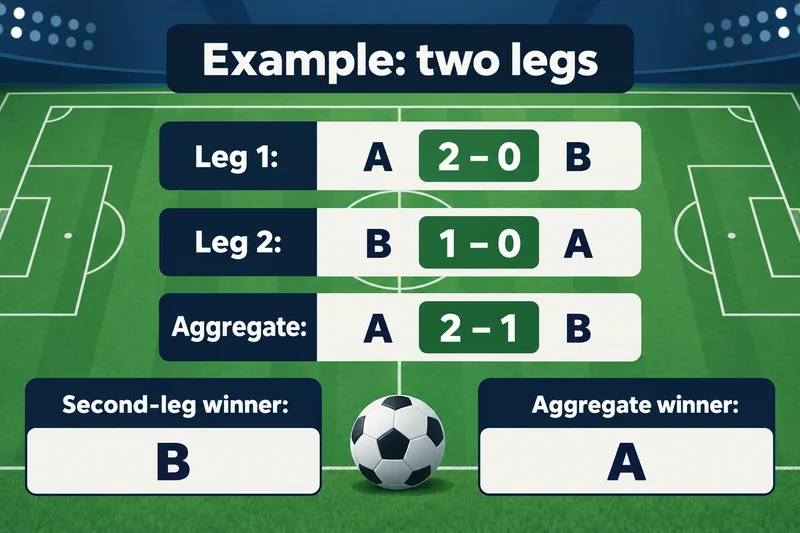
Consider two fictional fixtures. In the first leg, Team A is at home and beats Team B 2–0. In the second, Team B is at home and wins 1–0. Assume the competition decides this non-tied example by the combined goals.
| Fixture as displayed | Team A goals | Team B goals |
|---|---|---|
| First leg: A 2–0 B | 2 | 0 |
| Second leg: B 1–0 A | 0 | 1 |
| Aggregate, written A–B | 2 | 1 |
Team B wins the second match. Team A wins the example tie 2–1. Both statements are true because they describe different scopes. Simply adding the left-hand scores on two home-first displays would wrongly assign 3 goals to a single team. The left side changed identity between fixtures.
The word “winner” needs an object
IFAB Law 10 defines the match winner by goals scored and separately addresses competition procedures when a drawn match or home-and-away tie needs a winner. The current source was checked on 8 October 2026. The relevant competition rules determine which permitted tie-breaking procedure applies.
When reading a result label, expand “winner” into a full question: winner of this match, winner of the combined tie, or team that qualifies? In the example above, a second-leg match result points to B, while aggregate qualification points to A. An actual betting market also has its own stated scope and settlement terms; this scoreboard exercise does not settle a wager.
Change one goal and the arithmetic reaches its limit
Now change the second-leg result to B 2–0 A. Team A has 2 + 0 = 2 goals; Team B has 0 + 2 = 2. The aggregate is 2–2. Team B still won that second leg, but adding the two scores no longer identifies the tie winner.
This is where the competition’s rules become essential. Do not borrow an away-goals rule, extra-time procedure or shootout condition from another tournament or season. The arithmetic establishes equality; the applicable rule tells you what follows. A screenshot of the second-leg score alone may omit that stage.
A compact record that prevents the usual mix-up
Keep the competition and season, both fixture dates, the home and away identities, and the scope of each score. Normalize both legs into Team A and Team B columns before adding. Record the resulting aggregate separately from any later tie-break result.
If a display includes extra time or penalties, consult the regular-time, extra-time and shootout comparison. That guide separates periods within one fixture; the table here separates fixtures within one tie. Using both prevents a shootout tally from being added to match goals or one leg from being mistaken for the whole tie.
More interpretation guides are grouped in the sports section. The arionplay homepage links to the site’s other subject areas.
Source-based editorial research and original examples. Sources checked 2026-10-08.