
Scatter hits in 100 spins: exact binomial odds at a stated rate
Published — UTC
Short answer. Take a hypothetical scatter chance of 1 in 100 per spin and assume each spin is independent. A 100-spin session then has a 36.6% chance of no scatter at all and a 63.4% chance of at least one. The average is one scatter per 100 spins, but the average is not the most common outcome by a wide margin: zero and one hit are about equally likely. The 1-in-100 rate is used only to make the arithmetic concrete. It is not the rate of any real game.
The formula, and what it assumes
When a count comes from a fixed number of independent trials, each with the same success probability p, it follows a binomial distribution. The probability of exactly k hits in n trials is C(n,k) × p^k × (1 − p)^(n − k), where C(n,k) is the number of ways to choose which k trials hit. The mean is n × p and the variance is n × p × (1 − p). NIST’s engineering statistics handbook gives these definitions and the binomial model for counts of this kind (NIST, binomial distribution).
With n = 100 and p = 0.01, the mean is 1 and the variance is 0.99, so the standard deviation is about 1.0. The distribution is wide relative to its mean. That spread is the main point of this article: a single session can look very different from the stated rate without anything being wrong with the game or the counting.
Exact outcome shares at 1 in 100
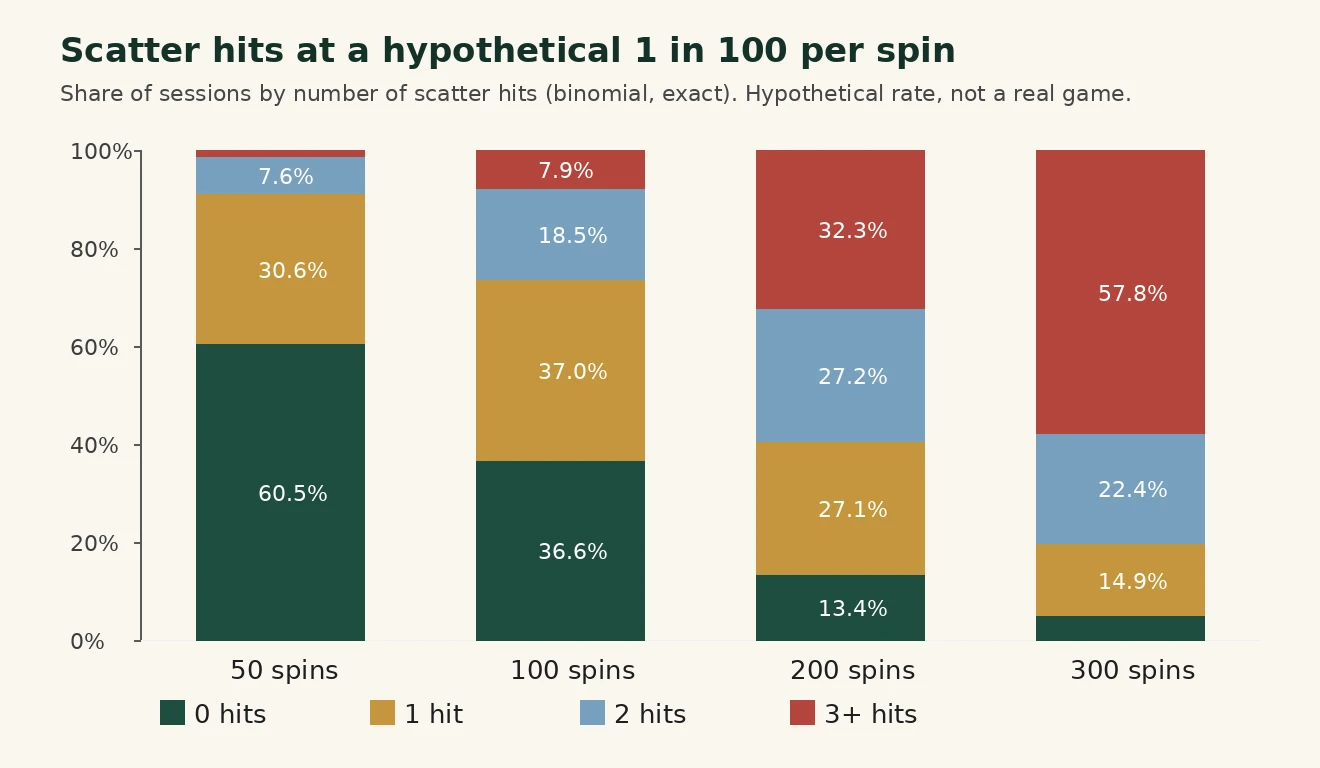
The table below uses the binomial formula directly for four session lengths. Each row adds to 100%, with rounding to one decimal place. The last column is the chance of seeing at least one scatter.
| Spins | 0 hits | 1 hit | 2 hits | 3+ hits | At least 1 |
|---|---|---|---|---|---|
| 50 | 60.5% | 30.6% | 7.6% | 1.4% | 39.5% |
| 100 | 36.6% | 37.0% | 18.5% | 7.9% | 63.4% |
| 200 | 13.4% | 27.1% | 27.2% | 32.3% | 86.6% |
| 300 | 4.9% | 14.9% | 22.4% | 57.8% | 95.1% |
A peso example at ₱20 a spin
Suppose a player stakes ₱20 per spin. A 100-spin session costs ₱2,000 and a 300-spin session costs ₱6,000. Under the hypothetical rate, a 100-spin session with no scatter at all happens 36.6% of the time, so it is an ordinary outcome and not a sign of anything. At 300 spins the zero-scatter share falls to 4.9%, roughly one session in twenty. That is uncommon, yet it is still expected from time to time, so one unusual session does not prove the rate is wrong.
The sizes of the numbers also matter for planning. The expected count at 300 spins is 3, but the chance of 3 or more is only 57.8%. A player who budgets for the average is therefore below the average in just over four sessions out of ten, so the expected count of 3 is a poor guide to what one session will show.
Reading one session against a stated rate
A useful question after a session is not “was the count average?” but “how often would a count this low, or lower, happen if the stated rate were true?” Using the same formula, a session of 300 spins with 0 scatters has probability 4.9% under the hypothetical rate. One scatter in 300 spins has probability 14.9%, so a count of 1 or fewer has probability 4.9% + 14.9% = 19.8%, which is common, not rare.
Two cautions apply. First, the calculation depends on the stated rate. If the rate that a game publishes is different, every number above must be recomputed with that rate. Second, one session can only support a weak conclusion about a rate, because the spread is so wide. Many sessions, recorded before the counting starts, are needed for a sharper estimate. The arithmetic does not tell you the real rate; it tells you how surprising a count is under a rate you already have.
Where the model stops
The binomial model is valid only when every counted spin has the same probability of a scatter and the outcome of one spin does not change the next. Many slot games break that assumption. Free-spin features, retriggers, cascades or bonus buys can change how a symbol appears from one spin to the next. In those cases, the count should be split by feature state, and each part should use the rate that the game publishes for that state. Pooling base-game spins and feature spins into one binomial count mixes two different processes.
The model also says nothing about payouts. A scatter count is a count of symbols. Whether a scatter pays, how much, and whether it triggers a feature are separate rules that need the game’s own information. Our table does not include any of those rules.
Checking the rate before you rely on it
- Find the scatter or feature rate in the game’s own information sheet or paytable, and write down the date you checked it.
- Check whether that rate applies to base spins, to feature spins, or to the purchased feature, because the figures differ.
- Pick the session length in advance. Changing the length after seeing the count invites the wrong conclusion.
- Recompute the table with the published rate, not with the hypothetical 1 in 100 used here.
What is verified and what is not
- Verified: the binomial formula and its mean and variance, from the NIST engineering statistics handbook, checked 2026-10-15.
- Our calculation: every value in the table and the chart, computed exactly from the formula in Python and rounded to one decimal place.
- Hypothetical: the 1-in-100 scatter rate, the 100- and 300-spin sessions, and the ₱20 stake. They illustrate the arithmetic only.
- Not verified: the scatter rate of any real slot game. No provider data is used in this article.
The most useful number in a session is not the average. It is the spread around it, which tells you how much a single count can mislead.