
A second-half score is not the full-match score
Published — UTC

A full-match score includes first-half goals. To reconstruct a second-half score from two cumulative snapshots, subtract each team’s half-time goals from its full-time goals.
Subtract by team, not by total alone
In this original invented match, Red versus Blue is 1–1 at half-time and 3–2 at full-time.
| Team | Half-time goals | Full-time goals | Second-half difference |
|---|---|---|---|
| Red | 1 | 3 | 2 |
| Blue | 1 | 2 | 1 |
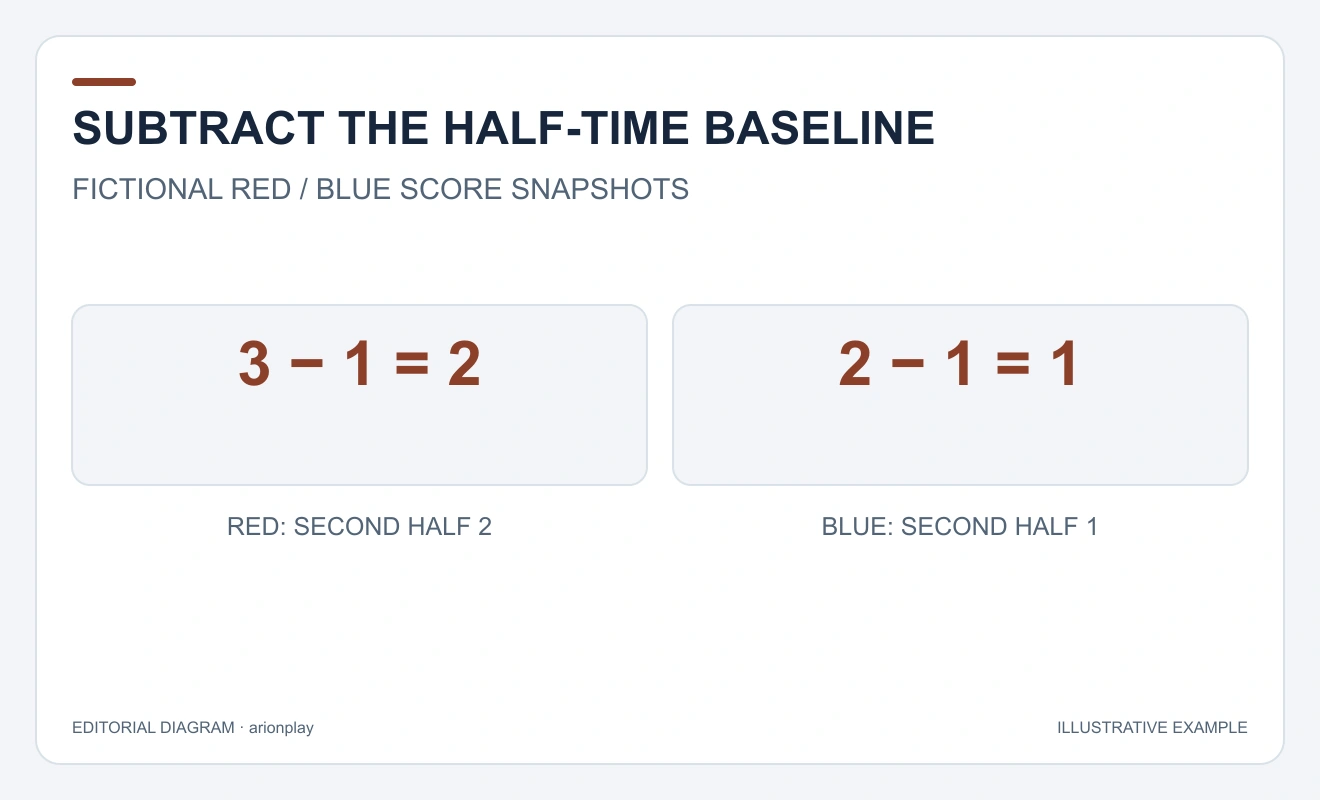
The second-half score is 2–1, containing three goals. The full match is 3–2, containing five. Writing 3–2 as the second-half result would carry both first-half goals into the later period.
Confirm the snapshots cover the intended periods
IFAB Law 7 describes the match’s halves and allowance for lost time. It does not define an operator’s market settlement. Confirm that “full-time” in the source refers to the period required by the actual market, and keep extra time separate where relevant.
Team ordering must also be consistent. If the second feed lists Blue first, normalize the labels before subtraction. A corrected goal record or an abandoned match may require the official period result instead of a simple snapshot difference.
Use addition to check the reconstruction
The recovered second-half score should rebuild the endpoint: Red’s first-half 1 plus later 2 equals 3; Blue’s 1 plus later 1 equals 2. Across both teams, 2 first-half goals plus 3 second-half goals equals 5 full-match goals. This checks the arithmetic, but does not certify that either source is official.
A total alone cannot tell who scored. A second-half total of three could be 3–0, 2–1, 1–2 or 0–3. Only the team-specific differences support the 2–1 reconstruction in this example. Retaining just 5 − 2 = 3 loses the winner and each team’s contribution.
A negative difference is a review flag
Suppose an older half-time snapshot credits Red with two goals, but a later corrected final record credits Red with one. The difference is −1. Do not change it silently to zero or describe it as a team scoring a negative goal. The records may use different revisions, events or periods. Find the corrected compatible baseline, or use the authoritative period result where the applicable rules require it.
Keep extra time and other outcomes separate
If a source’s final display includes an extra-time goal, subtracting the half-time score can include more than the second half. Preserve the regular-time endpoint as a separate field when that is the intended scope. A penalty-shootout tally is also not interchangeable with a goals snapshot.
Record fixture ID, stable team identifiers, period boundary, source status and revision time beside both snapshots. Stoppage time belongs to its relevant half; the operator’s settlement terms still determine which official record and period its market uses. A missing half-time value cannot be assumed to be zero just to complete a subtraction.